December 28, 201312 yr I 100% agree with backwoods, reduce the leverage on the ram head and guide rail by shortening the die length, stitch welding a plate on one end of the rails will stiffen the web up and build it with a good solid flat attachment to the base. it will work as it is for pressing thin pieces while everything is square and the dies are wide and flat. But once the log splitter bends or tears something it will never be the same, unless your repair skills are first rate. A few tweaks on the Mk2 dies and it should be trouble free for years.
December 29, 201312 yr Author @yahoo2 - what do you mean in your final sentence about mk2 dies? Thanks
December 29, 201312 yr It takes me 2 or 3 tries before i get things right, it usually goes prototype mark1, upgrade mk2, production model mk3. If I get beyond mk5 and there are still faults, its in the bin, I don't have that much patience. I thought at some stage you might modify the die with a more rounded fullering shape on the top half of the rail so you can fuller and flatten in the same heat or you could make some drop-in depth limit gauges that stop the dies from closing and keep things even as you work down to a size. Plenty of possibilities with a bit of lateral thinking.
December 29, 201312 yr Author Yahoo - Thanks for reply. Your response was great because in my initial post for this thread, that was my main question. Do you have any photos that show the die as you descibe it? In the video link below it shows the billet from start to finish. At 13:30, you can see, I added a large flat piece of steel to help, but I do think further mods are needed. Would love to see what 'real dies' look like for welding and drawing out. Thanks for input!
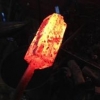
December 30, 201312 yr Author Here is a sample billet from this damascus piece - 66 Layers and has great definition. I am real happy:
December 31, 201312 yr Your pattern welds look great, not sure I am that excited about the snow outside, its 46o C here (that's 115 F) nice comfy warm dry heat. this is what I was thinking for supporting the web, just a plate (black line) welded on one end of the rail (would be best on the base I think) this gives structural support AND lets you weld both the front and back of the plate (orange lines) because you are getting welds directly opposite to each other on both sides of the plate they only need to be short welds, I just made a mistake with the drawing. if it was my press I would leave the rails flat and build a variety of slippers to go over the rail with different shapes welded on the front. mild steel would be fine then you can pick and choose and change them out on the fly. You could slip them down from the top with a spring clip holding them in place on the back. For a matched pair of slippers they could be joined together with a long piece of spring steel rod and held in place by the spring tension. the other thing that would speed your cycles up is clip-on depth stops to keep the ram retractions nice and short. I would make my own long ones and cable tie them on, but you get the idea. photo from griprite (depthstop.com)
March 21, 201412 yr Author update as of 3/21/2014 - 5-6 billets without any deformation. happy so far!
Join the conversation
You can post now and register later. If you have an account, sign in now to post with your account.