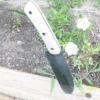
July 31, 201114 yr Hello everyone, Well, my wife and I decided to take a trip to J&J Flea market in Athens, Ga today. We live in Augusta, so it was about a 2 hour drive. I just had a feeling I would find something cool there because aside from UGA, there is a lot of farm land around the Athens area, so I figured there would likely be some blacksmith type materials. Well, this is what I found. It is some sort of hammer for working round bar I assume? (I really have no idea so someone please correct me). The reason I bought is is because I had tried to make some cable damascus last night, which ended in failure, but when I saw this hammer I new that it is what I had went to Athens to get!! I tried the cable damascus again tonight and I couldn't be happier. (I am making a separate post about that in the knife section) So, if anyone knows anything about this hammer such as name, maker, etc, I would very much appreciate it. Thanks, Adam
July 31, 201114 yr Thats not a hammer but a top swage a tool to be struck with a hammer sometimes in conjunction with a bottom swage
July 31, 201114 yr Author Oops, I guess I showed my ignorance on that one... Oh well, it does work pretty well as a hammer on cable -Adam
July 31, 201114 yr Top swage my foot! I've seen plenty of Hollywood westerns were the blacksmiths are swingin' em...... :lol:
July 31, 201114 yr The archeologists talk about tools of direct percussion and tools of indirect percussion. Hitting steel with a hammer is direct. Indirect is where you place a tool (object) between the hammer and the steel. The archeologists guess that it took a few thusand years for early man to figure out indirect. Your swage is a 3/4"D "half round" pattern used for smoothing up 3/4"D round bars or surfaces. A well made swage is not truly half round but rather, a scant half round. When in use, you can get edge marks, so some smiths smooth over the edges with a slight radius on either side of the swage cavity. This is usually done with a disc or belt sander. On your swage, you can see that the striking head is beginning to mushroom a little. That head is softer than the business end. I have people visit my shop occasionally, not always blacksmiths. Quite often, the ones who are strangers to smithing will remark, "You certainly do have a lot of hammers!" Their remark is based upon all the wooden hafts hanging from the tool racks. Of course, 99+% of them are 'top tools,' tools of indirect percussion. I used to try to explain the difference, but it seemed to take too long Today, I don't try anymore; I just say, "Yes, I have lots of hammers." BOLhttp://www.turleyforge.com Granddaddy of Blacksmith Schools
August 1, 201114 yr I try to refer to my rack as "Handled Tools" as the front row is hammers and the back row is swages, hot cuts, punches, etc. When I moved I had a grand counting of them and it turned out to be around a hundred "handled tools". Of course; I've bought more since then. It's nice to have the opposing swage for a top swage, why swage blocks were popular; however in my big anvil I have found that the 1.5" hardy holes are just about right for some of the top swages and so I've taken duplicates and forged the eye area of one of them down to fit the hardy hole and have sets that I can use on the anvil. (I also bought a bunch of battered damaged top tools just to have "starter" forms to forge into shapes I needed.)
Join the conversation
You can post now and register later. If you have an account, sign in now to post with your account.