warthog02
Members
-
Joined
-
Last visited
Everything posted by warthog02
-
Haha I don't know about being the better smith, I'm just obsessed with recreating old anvils. I hope the recovery goes well, we need more folks making these forge welded anvils as its such a lost skill, its insane to me how the making of something so fundamental to humanity's progression has so little literature and info on it. I hope one day to be good enough that I can make decent, good looking FW bench anvils that people can confidently work on. In the time I've had this one I've used it quite a bit for copper work.
-
That was a fun one, learned a ton since then. Definitely need to see about having another session at the farm
-
Hi all, Recently finished this 8 lb 12 oz forge welded 3 piece anvil. Here's a video on making it, let me know your thoughts
-
Ah I gotcha, yeah I do sometimes for really heavy drawing out but at a welding heat I can get a bit carried a way with that method.
-
Thanks all for replying. I'll see if I can have you over for the next project Flatliner, my powers have quadrupled since last we forged together >:) And to Frosty, Longer horns would have probably been more useful for sure, I partly just didn't want to push my luck and accidentally burn something. I also have a pretty long bickering that I can use if I need something like that.
-
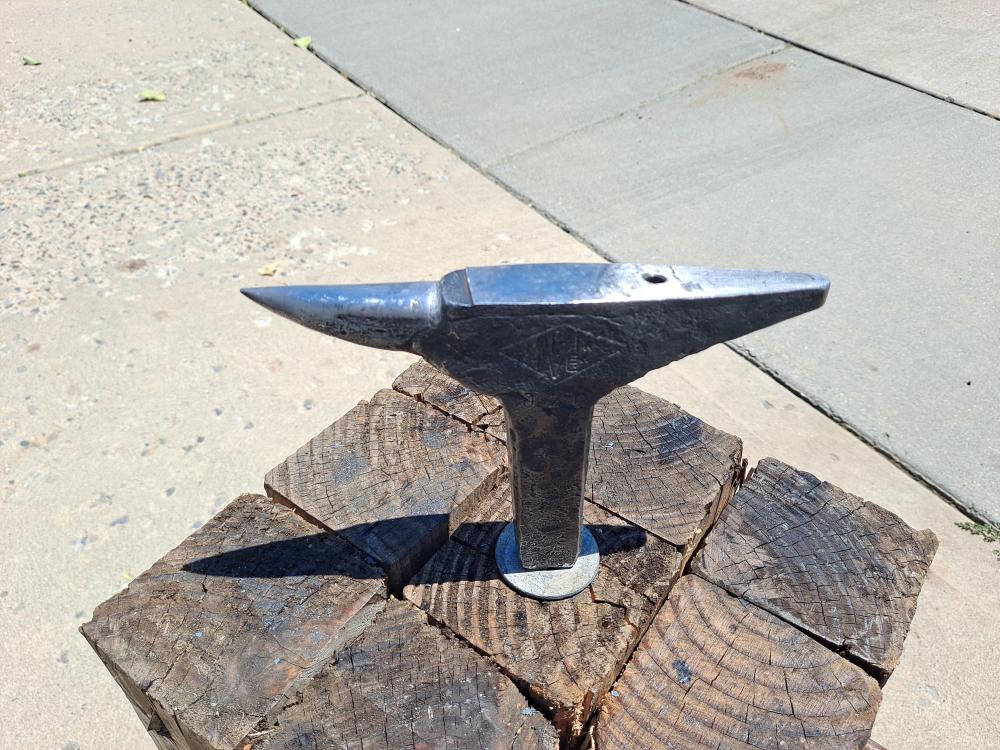
I finished making this forged stake anvil using traditional methods. It is made of 6 pieces of wrought iron and a hardened steel faceplate all forge welded together. Here's a video on making it
-
Looks like it has flat steps on the feet, which would indicate that its most likely a Peter Wright.
-
That's one of my favorite videos on YouTube. Can't imagine the amount of heat radiating off that thing. I hope to make a 20 lb anvil one day, 82 lbs is very impressive.
-
That's certainly valid, I had made a little stake anvil with just 2. This project was mostly to challenge myself and imitate the "build up" method early anvils would've been made by. I think postman said most anvils up to 80 lbs, even during the colonial period, were just 2 pieces. So taking 5 pieces to make a 5/8 lb anvil is definitely overkill.
-
The mild steel was stubborn in welding, so probably 6ish hours spread over a couple days. I hope to use wrought iron for my next one.
-
Yeah I didn't want to speed it up, but my phone camera just didn't pick up much detail with how bright it was glowing. Hopefully in another video I'm able to get better footage.
-
That i'm fairly sure is a Trenton. I'd have to double check the book on when they stopped having "A" before the serial number. But that is indeed the Trenton way of stamping the weight and serial number. Arm and Hammer I believe also only has serial numbers up to about 50,000.
-
I'll make this thread for anyone interested in making anvils using the traditional forge welded method. I recently was able to make a 10 oz mild steel anvil, of 5 forge welded pieces with no pre tack welds. I hope to make more of these and eventually get up to a 10 pounder. If anyone else has forged an anvil, ideally by forge welding but even one piece it'd be cool to see it here. I did a video on making the small anvil, but didn't get a lot of footage of the first few welds. It has a tool steel top, however, and besides its size it is functional as an anvil and stays together. https://youtu.be/OrZn3NP7cQ0
-
I reckon a few oxy cut marks would look great on that one. No, but as George said it reminds me of when the Japanese made the massive battleship Yamato, which had the biggest guns, toughest armor, was one of the most formidable and powerful ships of the time. And it promptly sat in the dock for years out of fear it would be sunk (which granted it was). But unless you plan to have it only to eventually sell it, it'd be good to use it, at least a little bit, for small projects that will preserve the originality but still give it purpose beyond eye candy.
-
I'm hoping to visit that museum one of these days, it's quite a ways from me though so the book will have to do. I made a pretty simple chain mandrel for my 90 pounder, still need to trim the wedge and maybe made the swage a bit deeper

-
That one's a beauty, definitely more what you think of in chain makers anvils than mine lol. It's interesting how fisher anvils had two side holes in anvils as small as their #3 at 170lbs.
-
Here's another video I got a book on chainmaking too called Chain and Anchor making in the Black Country and its got some good stuff. The place where I demo for work I make lots of chain links, no I just need to convince my boss they need two anvils.
-
Recently acquired this 90 lb Chain Makers anvil. Its of the old english style and is pretty corroded so i havent found any markings. The surface is in good condition though, having been rewelded after lacking a large chunk of the faceplate. Getting this as well as seeing some old videos of chainmakers at work has gotten me fascinated with forge welded chain making recently. I plan to make a chain making mandrel for this anvil at some point so if anyone has pictures of such tooling that'd be awesome. Or if anyone has other chain makers anvils I'd love to see them

-
That one's strange, I've never seen a cast anvil with stepped feet. It looks somewhat similar to cast steel anvils like brooks or KL
-
Hi all, I've had this colonial for a while and I'm dead set on trying to discover it's maker. It's about 190 lbs, has no cutting shelf so is pre 1780 at the latest, though I feel is much older. The only suggestive mark I have found so far is right above the fifth foot which, if anything, I believe would be a 3 or an S. A 3 could be reasonable, with a hundred weight of possible 1.3.x. But it could also be and S, maybe stamped crooked, which according to Postman would make it a very early mouse hole. Other points of interest are how out of line the horn is, how on the opposite side of the fifth foot it is very reminiscent of church windows, and the face plate which appears to use two separate pieces. It looks very similar to a fifth foot anvil featured in AIA with an S above the fifth foot, except for how rounded over my anvils fifth foot is. Let me know if yall have any insights on this


-
From Josh's book it says paper labels were introduced in the 20s, so it's possible they were around in 1917. It also says during ww2 that the cast logo was removed for anvils sold to the US government, so maybe the same was done for ww1. It could have also just been ground or worn off for whatever reason
-
Haha don't spoil the secret. Third times the charm so now I only need one more 300 lber.
-
I got another decent deal on a 300 lber, this time a Fisher from 1917. Edges are pretty beat up and lots of marks on the horn and cutting plate but the face is near pristine. No Fisher logo but a big "Fisher" stamp next to the front mounting hole. I know AIA talks about how the eagle logo was removed for the south during the American civil war, but Idk why they'd still be doing that by 1917 if anyone knows about that. The rebound is excellent, some of the best I've seen. Managed to fit it on the same stump as my stake anvil which may serve as a nice upsetting block.

-
It's still very possible it was made during ww2. The military used anvils a lot and still does. A portable anvil like this would he perfect for the field. Trenton for instance manufactured fewer than 1000 anvils from 1939-40, compared to almost 8000 from 41-43
-
I got the book off ebay, I'll just call it an early christmas gift. That's what I got too, the 1941 to 1943 figure. I also got this I believe Brooks stake anvil weighing 40 lbs, which likely was also made during world War II according to its seller.