
Tim grows Vegetables
-
Posts
7 -
Joined
-
Last visited
Recent Profile Visitors
242 profile views


-
Hi, For a couple of days now I've been looking around online regarding ironworking technologies, especially steel making and wrought iron production processes. I'm a little confused about the Aston Process. It is my understanding from the sources I've looked through that the Aston Process was developed to take advantage of the very efficient way that Bessemer converters decarburized pig iron which enabled fully decarburized iron to be poured directly from the converter into "cooler liquid slag" to combine and form wrought iron that was then rolled out into muck bars. But there's been a recent topic on 1008 low carbon steel etc and how great it is to work with. If you can make low carbon iron directly in a Besemer converter, why do you need to mix it with slag to make wrought? Why not just pour the iron and make it into bars without the slag? That's the part I don't understand. Why add the slag back in to make wrought when the converter had already separated out the original slag the pig iron might have contained? There must have been a good reason to create and industrialize the Aston Process, but I don't understand what it was.
-
Very lovely. It is almost an Art Noveau frieze mounted on the wall that way.
-
Barn roller Fire place doors
Tim grows Vegetables replied to David Kailey's topic in Member Projects
Are the textured areas in the fullered grooves from scale or is there some texture on the fuller? The close up image is really cool looking -
What did you do in the shop today?
Tim grows Vegetables replied to Mark Ling's topic in Blacksmithing, General Discussion
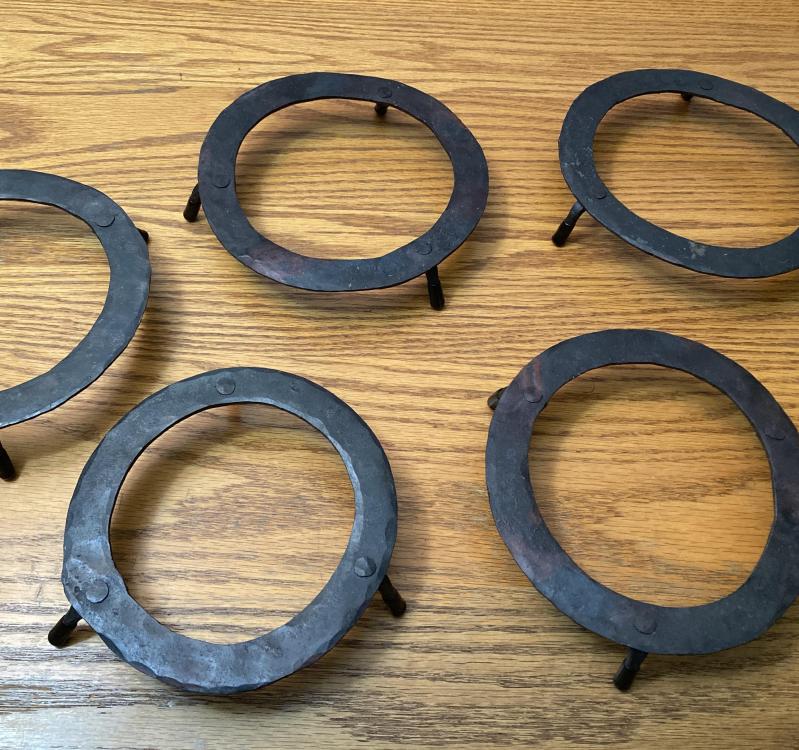
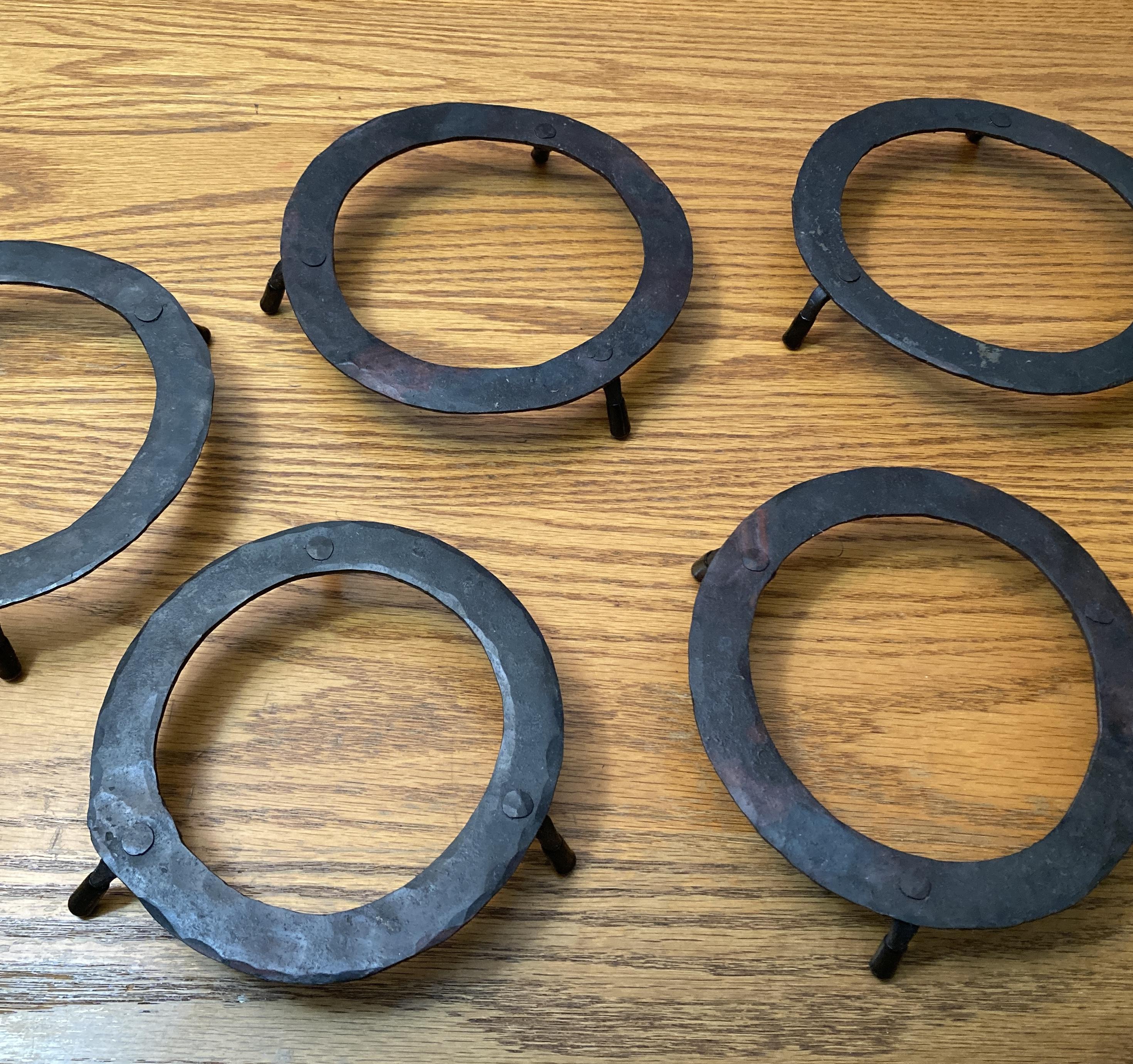
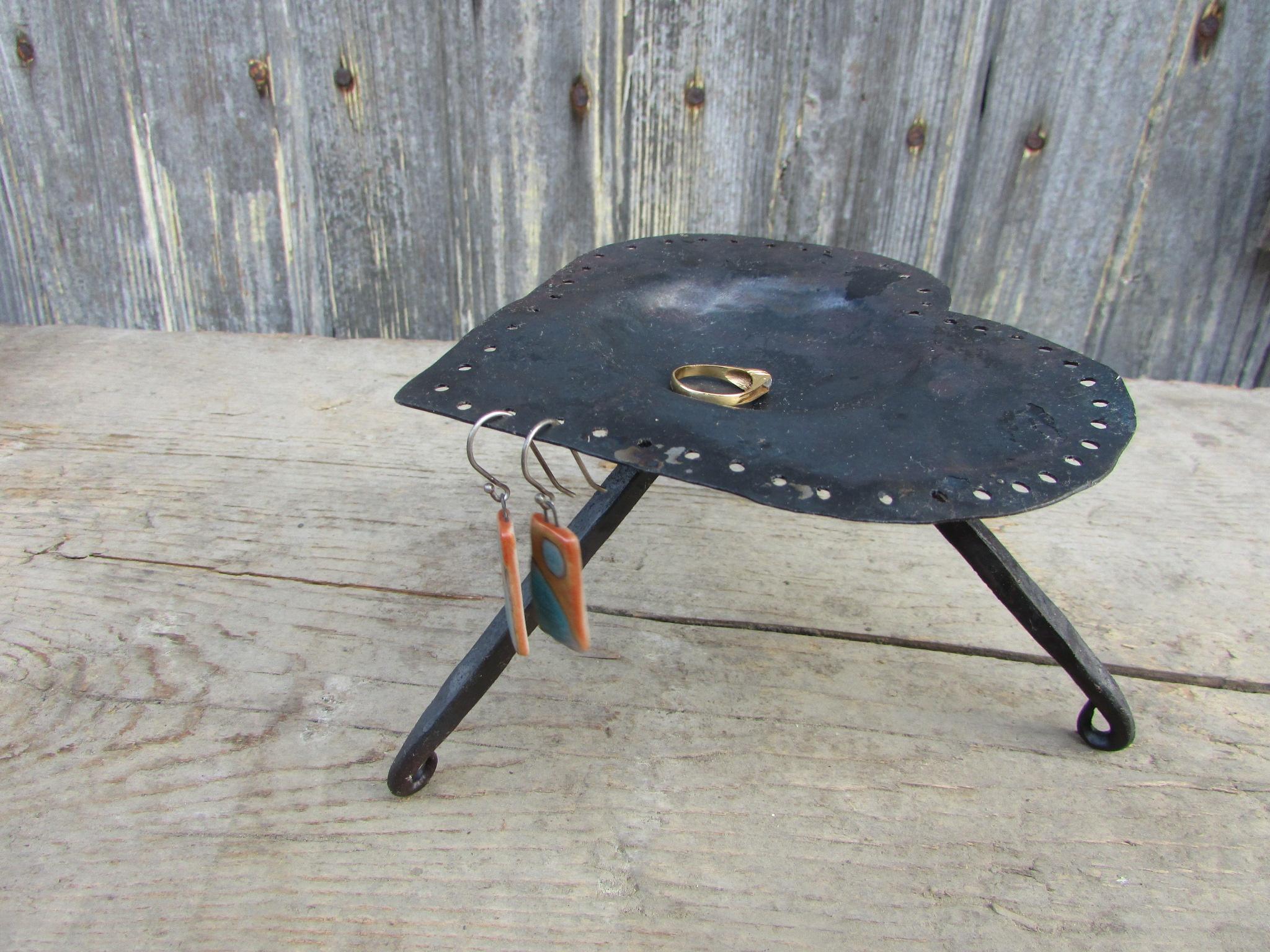
A bunch of tea light holders, two finger-hole candleholders (I don't know what the proper thing to call these is), a pull handle, and a pair of hooks for hanging a pair of ukuleles.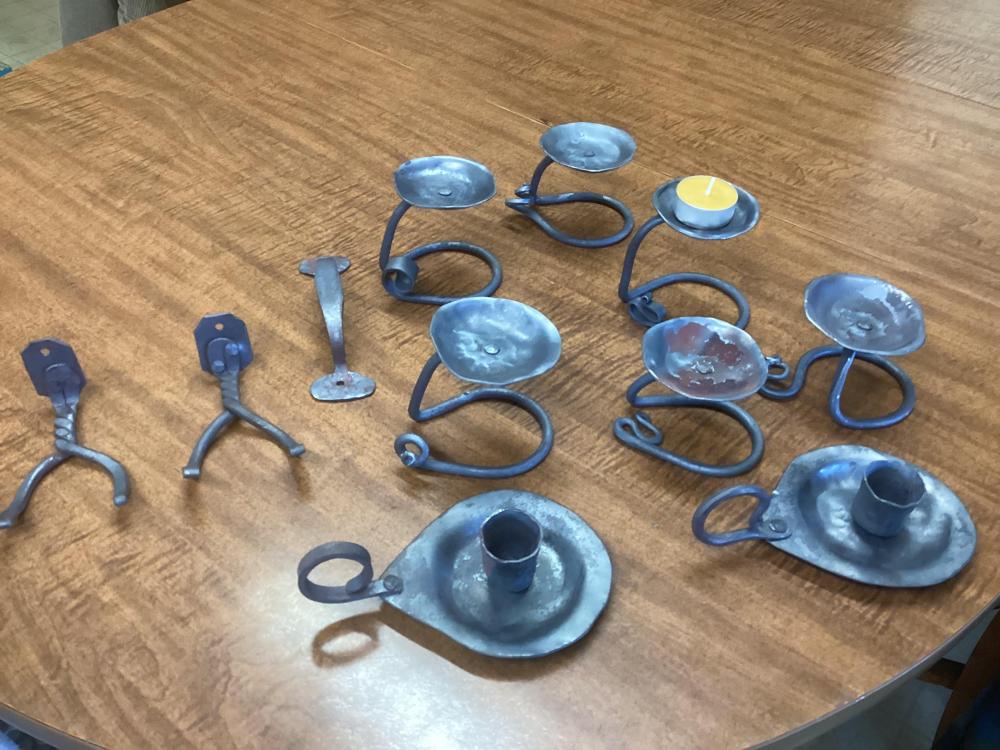
-
Sorry, My mental fraction math went out the window writing that description. It was more like 5/16ths square, not 5/8ths. the ball diameter was a little more than twice the width of the square stock. I am kicking myself for not taking a bunch of pictures, it was really cool and I had my phone right there.
-
Today a potential customer came up to me at the farmers market where I vend my produce and forged stuff with a really cool old piece. I wish I'd had the presence of mind to take pictures of it. It was a swing arm made of 5/8ths square stock appoximately 30' long. The pivot ends of the arm were set down and had very small (3/16?) holes for a pivot pin. Under the two square bars was a thin 3/16ths wire that suspended from the lower bar the length of the arm. The guy called it a "swing arm banner hanger" The upper bar had a sheet metal indian head profile riveted to it and the end of the lower bar had a 3/4' faceted ball end on it. There were also two short 5/8's square braces that connected the two bars with rivets and little scrolls. All in all a very cool old piece. The square stock had lots of faint hammer facets that looked like it had been forged down to size from larger stock. The wire on the bottom looked like machine drawn wire though. He wanted me to make a bracket-hanger with a similar ball end that had a 3/16' pintle to swing this arm off of. I told him it was beyond my skill set to make a faceted ball end pintle. Especially since he wanted it next week. I think he's going to have trouble finding someone to make that for him that quickly. I've never considered making a ball end. I looked up "ball end" and found some discussions but all the image links were broken. What would the best procedure/process be for makeing a 3/4 inch faceted ball on the end of some 5/8 inch square stock? It seems like the best way is to forge weld on a collar and then forge the resulting end into a sphere? It would definitely take me many many attempts before I could ever get such a thing down, expecially without messing up the bar the ball was attached to at least a little. '''
-
Hi, My name is Tim. I guess I first tried blacksmithing around 2001 when I worked at a living history farm in NJ. There was a coal forge setup on the farm, as well as another forge on an adjoining property not open to the public. I helped the demoing smith a few times and goofed around with making S hooks and stuff. Afterwards I didn't really touch blacksmithing again until we bought our farm here in NY and I'd been forging on and off as a hobby. My neighbor loaned me a Peter Wright which I am still using, and I bought a post vise off CL. I've been slowly making my own tooling pretty much since then, and mostly forged hardware, hooks, hinges, etc. I've not messed with bladesmithing much, although I'd like to make an axe someday. My main occupation is as a vegetable grower. We sell most of our produce at farmers markets and some wholesale to restaurants. It isn't a way to get rich but we do OK. When Covid hit, my wife suggested I try selling some of my forged stuff online, so we tried doing an Etsy shop for a while. That was pretty much a bust, there are lots of smiths well established on Etsy that sold pretty much the same stuff I was trying to, and it seemed like you had to get really good at SEO to make an Etsy blacksmith business work well. But I had all this forged inventory I'd made for the online thing, so once Covid cooled off and we could go to farmers markets again, I started selling ironwork alongside the vegetables. It was kind of a hassle to start as that farmers market has a lot of complex rules for artisan businesses vs agricultural businesses, but ultimately we have been able to have a decent side income at market. It is a college town and there are lots of tourists that come through the market, otherwise I don't think ironwork (or other artisan stuff) would be viable. I do sell some stuff to local folks, but most of the ironwork sells to visitors. It feels weird because I am definitely an amateur smith, and sometimes customers want to commission really elaborate stuff that I DO NOT have the capability to do. So I feel a lot of 'imposter syndrome' sometimes. I have attended a handful of meetings of the Southern Tier region of the NYSDB, but it is difficult for me to get to them as I do farmer's market on Saturdays when the meetings are held. I would like to get to some this winter if I can. I did learn quite a bit at the meetings I attended. I've been a very frequent visitor to this forum looking for information, so I thought I should finally create an account. There is a new vendor at the farmers market who is a bladesmith selling amazing coooking knives, (and a much better smith than I am) and he's been great to talk to. I realized I should communicate more and learn more. I'd like to professionalize my forge setup a bit. Its kind of a dog's breakfast and I would be ashamed to have a real smith look at it. I need better lighting and more electrical outlets on my bench so I'm not constantly switching what is plugged in when I need to use the bench grinder vs the drill press vs the angle grinder. I am in the process of switching the Peter Wright out with a Vevor anvil I purchased. I like the PW but it doesn't belong to me, and it has some "old anvil" problems that I don't really feel I have a right to do anything about since it is a "free loaner". The horn has tons of chisel cuts and cutoff wheel cuts that really chew up the surface of anything I forge on it, and the edges have a lot of chips so I have to hunt around for the good radiused areas. I don't know how good the Vevor will be, I'm still setting up a stand for it. I plan to move the PW out to my old hobby forge in the shed. I used coal at that time, I switched to a homebuilt propane setup when I started forging for sale. I couldn't fit a flue for coal into the little garage where I have electricity. In terms of what I'd like to learn. I'd like to be more efficient. I'd like to find some more projects that I can make easily for sale. I'd like to really get forge welding down, and make some more complex items. I've done a few suffolk latches and various size hinges, but not enough to really be GOOD at them. I'm interested in being safer, and taking care of my joints. I don't think I'll be able to spring for a power hammer, although I'd love one. One thing I'd really like would be a shear for cutting small diameter stock like 1/4, 5/16, 3/8, and 1/8 flat of various widths. I end up cutting batches of everything and in my mind a shear would be more efficient. But I'm not that familiar with what is available.