
Greg Heffley
Members
-
Joined
-
Last visited
Everything posted by Greg Heffley
-
I just tried casting a ribbon burner out of kastolite30 and it totally came apart. I have made several before but with different refractories, and this kastolite is all thats available to me right now. I mixed in 18% water by weight just like the instructions said. I greased the mold and sprayed the straws with WD40. After pouring and inserting the block, I let it set at ~20C for 36 hours before demolding. After removing the sides of the mold, I tried to gently pull the block off the faceplate (that holds the staws). The plenum just separated instantly from the block. Pictures attached. Is there anything I'm doing wrong? Should I give it more time next time? I've never used the kastolite before and I'd like to have a good idea of what to change before attempting again.
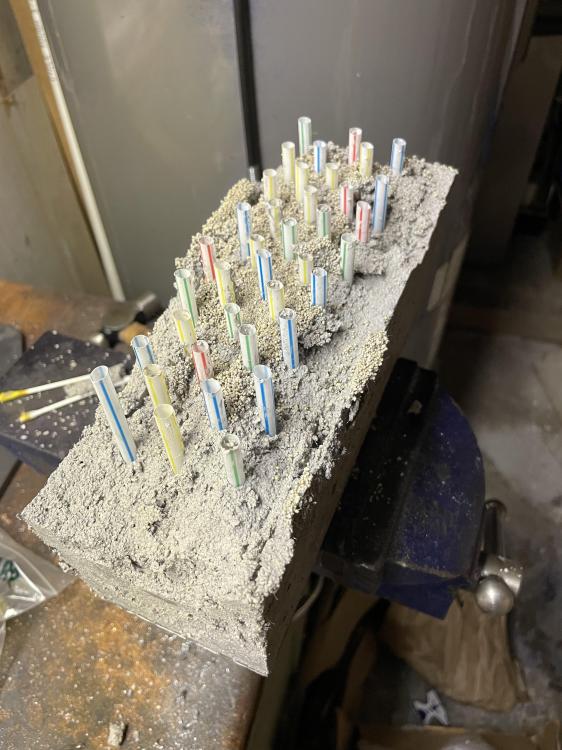
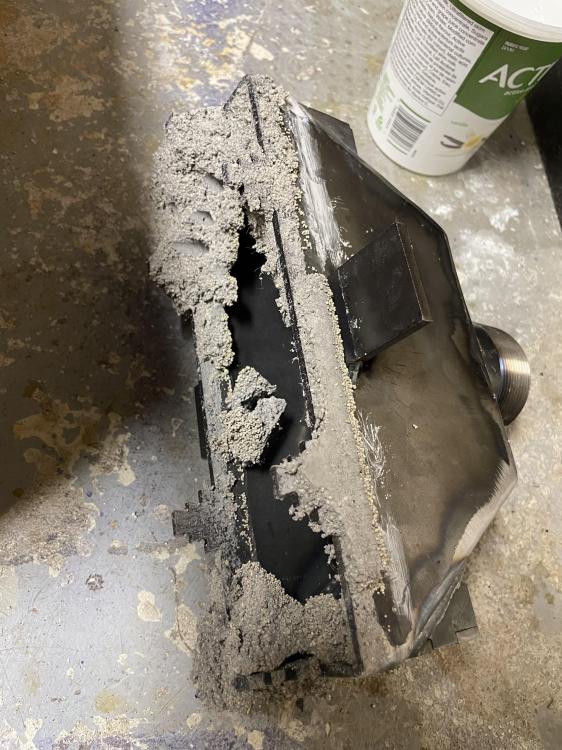
-
Hello everyone, I'm designing myself a new ribbon burner forge after the old one was just too worn out to continue. My old one was round and I like that there was a good flame swirl but I didn't like that there was alot of unusable space on the sides. I'm thinking of doing this one as a mailbox style to have all the space usable, but I'd like to get the angle of the burner good enough that there is at least some degree of swirling to keep the heat more even. What angle should the burner come in at? in this design, it's currently straight horizontal, but I'm not sure if the rounded top is enough to efficiently redirect the flame without some of it bouncing back. From those who have experimented with this, is it better to tilt it slightly? Maybe a 5 or 10 degree angle? Forge chamber dimensions are 6" wide, 7" tall, 6" diameter curve at the top, 15" long.

-
I have seen posts about a203e being good for damascus, but what I'm wondering about is if there is always a visible grain/banding when it's etched. I have seen several pictures of san mai blades with a203e cladding, and there is quite a beautiful and noticeable grain visible. Is this something that only occasionally happens in the odd piece? Is it a consequence of some part of the forging process? I'd like to hear from anyone who has experience with this steel, what your observations have been.
-
Hello all, I have been using my homemade ribbon burner for many months now and it can get hot enough to melt steel if I want (not that I ever want that). I have been using a 5 peak hp shop vac as my blower and it's very loud, I'm looking to get a quieter one and saw the blacksmith blowers. How would these compare? I can find the cfm on my shop vac (115) but no indication of pressure/ inches WC. All I know is it practically flaps my cheeks if I put my face in front of it lol. Here is the link to my shop vac: link removed Just wondering because I don't want to have to do a ton of fiddling and redoing my burner design to work with a new blower, I'm very busy and simply can't spare the time for that. I'd rather have a loud forge that works over a quiet one that I spend weeks troubleshooting.
-
I have some wrought coming in the mail and will soon be placing an order with admiral. I'm thinking of getting some of the a203e high nickel to try some decorative damascus. I've seen the a203e have visible grain similar to the more refined wrought, and while either metal will look great on its own, I'm wondering about pattern welding the two. I've seen etched wrought turn anywhere from light gray all the way to almost black, and I'm wondering if theres any way to control that to get a good contrast (like just etch time? etch medium?). I'm hoping for something with fairly good contrast (doesn't have to be crazy) and bold enough that you can see the grain in each of the separate metals still, I think it will look great. Also, is there anything bad to do with wrought as far as pattern manipulation? I'm hoping to do a twist pattern but I'm not sure if that would tear the WI. It's torn on me before when punching and drifting a hole in it so I'm curious.
-
Just emailed them, I guess well find out!
-
Hello, I'm from manitoba but I haven't been able to find any wrought iron here. I am doing a project where I will need to make several large overlays that I want to do in wrought iron, but the only place I can find that sells it in good quantities is in the UK and I can't find any locally. Would anyone here in ontario be able to sell me some wrought iron at a decent cost? I'd need larger pieces, anchor chain, wagon rim, etc...
-
Hello all, a while back I made a knife with 52100 bearing steel and I got some pretty cool looking banding (which I know is supposed to not be good). BUT I have a project where I'll need several decorative overlays that I would like to make a little more visually appealing than just plain steel. I dont want something as striking as damascus but I saw the old picture of that knife I did and I thought it would do just the trick. I've heard kevin cashen supposedly has a post somehwere explaining how to do this but I havent found it. So can anyone tell me how to succesfully recreate this banding pattern in my steel? Is it entirely to do with the heat treat and how the carbides group or do you have to get lucky with your piece of steel?
-
Yup! I don't much care if anyone beats it later, it's just fun to doing this. It's also going to be a project to improve my fabrication skills, lots and lots of pieces going into this, tons of welding, and tons of thinking going into putting this thing together. I would love if someone came along and beat it, it makes a fun competition. I'm just concerned with the type o steel I'm going to use to make a good edge for this monster.
-
OK, so I'm making sort of a novelty project: world's heaviest thor's axe, Stormbreaker. This thing will weigh well over 100 pounds, probably closer to 130-150. I'm making it with a proper hardenable edge and striking face, just because why not, may as well make it functional in case I find someone really strong to wield it. The bevel angle on this is quite wide and obviously It's not going to be that sharp, the sheer force of this thing coming down would probably destroy any regular high carbon knife steel. Michael Cthulhu, who makes ridiculously large knives and swords like this on youtube, uses hardox AR steel for his blades. Just wondering if that would be the best option for this, as it's extremely tough and abrasion resistant. Hardox 600 can also reach a fairly high rockwell and has the same carbon content as 1045, which a lot of axes are made from. IO'm venturing into unknown territory and none of my know how on knife and sword steels will help me here.
-
I am looking at making a forge press, but I am seeing totally different components from everyone's different presses. Some people say 5hp can get you 50tons, some say it can't even get 20. My question is, I can easily get a 5hp 3450rpm or 1750rpm motor locally, so if I paired that with a 16gpm pump, what size cylinder can I expect to push at a decent speed with that? I know the calculations, but I really just don't know what kind of speed I should be shooting for. I'm not picky about what kind of tonnage I get as long as it's more than 20. I can get a different size pump as well but 16 just seemed to be the most commonly used one with a 5hp motor. Also, I've seen most of the responses to these types of post just saying "it depends", which really isn't helpful, so if no one has a relatively straightforward answer I would prefer to just not read unhelpful ones. I know these things all depend on what components you pick, but I'm asking what I can expect to get with a 5hp motor and (probably) a 16gpm pump.
-
So I just tried to make my first billet of damascus, and after only two heats the handle broke off. I had beveled the edges and welded it solid the whole way around to the billet, so I was pretty sure it would hold. Unfortunately it came apart on one side and peeled apart the layers it was still attached to, so my billet was ruined. Any tips to keep the handle on longer?
-
Sorry, that should've said I've tried forge welding stainless to mild before and it didn't go so well. I can get consistently excellent welds on carbon or mild steel by itself though. I've heard all the stuff about stainless being super difficult, that is why I said I thought it would be suuper hard I've seen people stack and layer, then put a canister around. That is what I was thinking of doing with this one.
-
Do I need the flux if I'm using a canister? And I've tried forge welding and mild before it wen't pretty bad. I thought stainless welded better to itself than to mild steel
-
Ok cool, Do i need a different flux or is borax good? Although, I probably wont need a release agent if I use a mild steel square tube, I doubt it will weld to the stainless
-
I'm looking a making my first stainless damascus, but I don't have a tig welder. I'm just wondering If it will still work to stick weld the can around it. Also, I've heard of many different ways of doing it, like putting cardboard in the can to burn out the oxygen, using a clay slurry in the can, wd40, air hole, etc.... For the air hole, (this is a stupid question, but I want to know the meaning behind it) is there a specific spot to put the air hole? Because i thought the whole point of can welding it was to prevent air from getting in. I also know you need to relieve pressure but I'm just wondering how those two can both work.
-
I suppose I can just be the guinea pig, bite the bullet and order it. I'll give it a test and post the results in case there is anyone else wondering the same thing.
-
The specs say carbon content is 0.7/0.83 and the manganese is 0.3/0.8. However, I'm just asking because that is a huge range and I know a lot of people have had discrepansies between the specs and their actual order. I just though it would be better to find out from someone who's ordered from there. I know most people order from aldo but there is a huge difference in shipping getting steel from him versus admiral in canada so if I can get useable stuff from admiral I will take it. Blade quality isn't as important to me because this batch will probably just be used for jewelry. I emailed them but they basically said "it depends". Not looking forward to dealing with THAT customer service. C=.70/.83 Mn=.30/.80
-
Hi, I'm about to make an order from admiral (I've heard mixed things) and I noticed on the quote it said 1075 when I asked for 1080. On the online store, it says 1075/1080. Is it just supposed to be a mystery draw which steel you get? I honestly don't mind if its 1075 as long as it still etches dark like 1080 or 1084. That has to do with the manganese content right? Since I've heard bad things about their spec sheets, I was wondering if anyone with personal experience could let me know how it etches. Thanks
-
So I recently had to drill a lot of copper and brass and currently have a worktable covered in powders of both the metals. I was wondering if I might be able to put the powders and shavings in a steel canister and put them in the forge. I know you can do This and weld It together with steel powder, but I was just wondering if it would work with these metals. Could I just let it melt together in the canister? Would I have to forge it a bit? Also, if it works, would they just melt together and create a different alloy or would I get a pattern?
-
Ferric Chloride solution diluted half and half.
-
Hi, I know this isn't the right topic for this but I figured knife people would know alot about damascus. I just made a batch of cable damscus rings using EIPS Bright cable. I pulled them out of the etch after an hour and it looked great, neutralized it in baking soda solution and it still looked great. But then I went to dry it off and the pattern rubbed off on the towel. I tried re etching it and just letting it sit after the etch instead of drying it with a towel, and the pattern just faded away. Anyone encountered this before?
-
Hi folks, Im building a new gas forge and trying out a ribbon burner because i've heard they're quieter and I've been getting some noise complaints from the neighbours:) It definitely is quieter but it's not quite heating up like my last forge. I used to be able to get up to welding heat in about 5 minutes but I don't seem to be able to get up to welding heat at all in this new one. This forge is about 100CU bigger than the last one. I've attached the same plumbing to the plenum that I had running my 3/4" forced air burner in my last forge. The ribbon burner is 6" x 3" with 14 holes and is fed by a 3/4" intake that runs into 1" piping where the fuel and air mix. I know most people use bigger pipe but this setup worked excellently for my regular forced air burner so I thought I'd try it out for this. Do I need bigger pipe? Also, I've had to run it at 20psi gas pressure to even begin getting a flame, with low or high air volume. The blower is a shop vac rated at 168 cfm. Should I just make this new forge smaller? If I use bigger pipe will my fuel consumption go way up?
-
I followed his plan and used a 1” to 3/4” reducing tee, with a 6” pipe nipple and a merchants coupling nozzle. I honestly don’t know what to do.
-
Ok so I’ve made a small forge now, with Frosty’s t burners, an they work great outside the forge, but inside they sputter a lot and are very weak. Again, if I blow into the forge it gets much hotter, which leads me to believe it’s the same problem as before. This is really frustrating so if anybody has a straightforward answer I would appreciate it. I am just about out of money so I can’t build a whole new system. Would it fix the problem if I plugged one end of the t and attached a small blower at the other to increase the air getting in?


